
Preparations for fire seasons to come
This post examines how climate-driven wildfires have become system-wide risks for the United States, with damages extending far beyond burned acreage and destroyed structures. It focuses on the economic, public health, and ecological impacts of worsening fire weather, drawing attention to estimates that place the annual national burden in the hundreds of billions of dollars. We argue that better accounting of these interconnected losses is essential, but not sufficient. Policymakers also need stronger climate data and computer models that can anticipate where wildfire damages are likely to emerge before disasters occur.
Wildfires are a natural part of many ecosystems. When a warming climate leads to drier conditions, wildfires are more difficult to manage and their potential for destruction increases. In discussion of the climate-wildfire connection, the National Oceanic and Atmospheric Administration (NOAA) cites research showing that the warming climate in the western U.S. has doubled the number of large fires between 1984 and 2015. NOAA also notes that rising temperature and decreasing moisture are the main drivers increasing the likelihood of weather conditions suitable for fire. This post explains how climate change is intensifying wildfire risk, examines the resulting ecological, economic, and health impacts, and considers ways to reduce future harm.
How climate change affects wildfire
The relationship between climate change and wildfires is complex and shaped by many interacting factors. Explanations that apply in one place or period may change as conditions and events evolve, and forecasts of wildfire frequency and intensity depend on how those events unfold. Still, research and observation point to several important patterns in how climate change affects fire risk.
The warming associated with climate change can lead to wetter or drier conditions. In dry regions or seasons this intensifies wildfires by making landscapes hotter, drier, and easier to ignite. As greenhouse gas emissions raise global temperatures, warmer air draws more moisture from soils, grasses, shrubs, and trees. This drying effect turns vegetation into highly flammable fuel and lowers the threshold for a spark to become a major fire.
Climate change is also lengthening the fire season. The National Park Service (NPS) reported at the beginning of 2025 that fire seasons in parts of North America have expanded by up to two months. Earlier snowmelt, hotter nights, reduced summer rainfall, severe drought, and stronger heat waves leave forests dry during the periods when they most need moisture. NASA scientists note that these changes allow fires to start more easily and spread with greater speed and intensity. A 2024 U.S. Environmental Protection Agency (EPA) report found that U.S. wildfire acreage has generally increased since the 1980s, with most of the highest-burn years occurring since 2000.
Warming also increases wildfire risk indirectly by disrupting forest ecosystems. Shorter, milder winters allow pests such as the mountain pine beetle to survive across larger areas, killing trees and leaving behind extensive dead timber. The Center for Climate and Energy Solutions (C2ES) explains that this dead organic matter dries quickly and becomes volatile fuel, helping fires burn hotter, spread into forest canopies, and become harder to contain.
Finally, wildfires reinforce climate change itself. For instance, forests normally store carbon, but when they burn, they release carbon dioxide and smoke while losing future carbon-storage capacity. This added warming intensifies the drought, heat, and dryness that fuel future megafires, creating a dangerous feedback loop.
The implications for economic systems
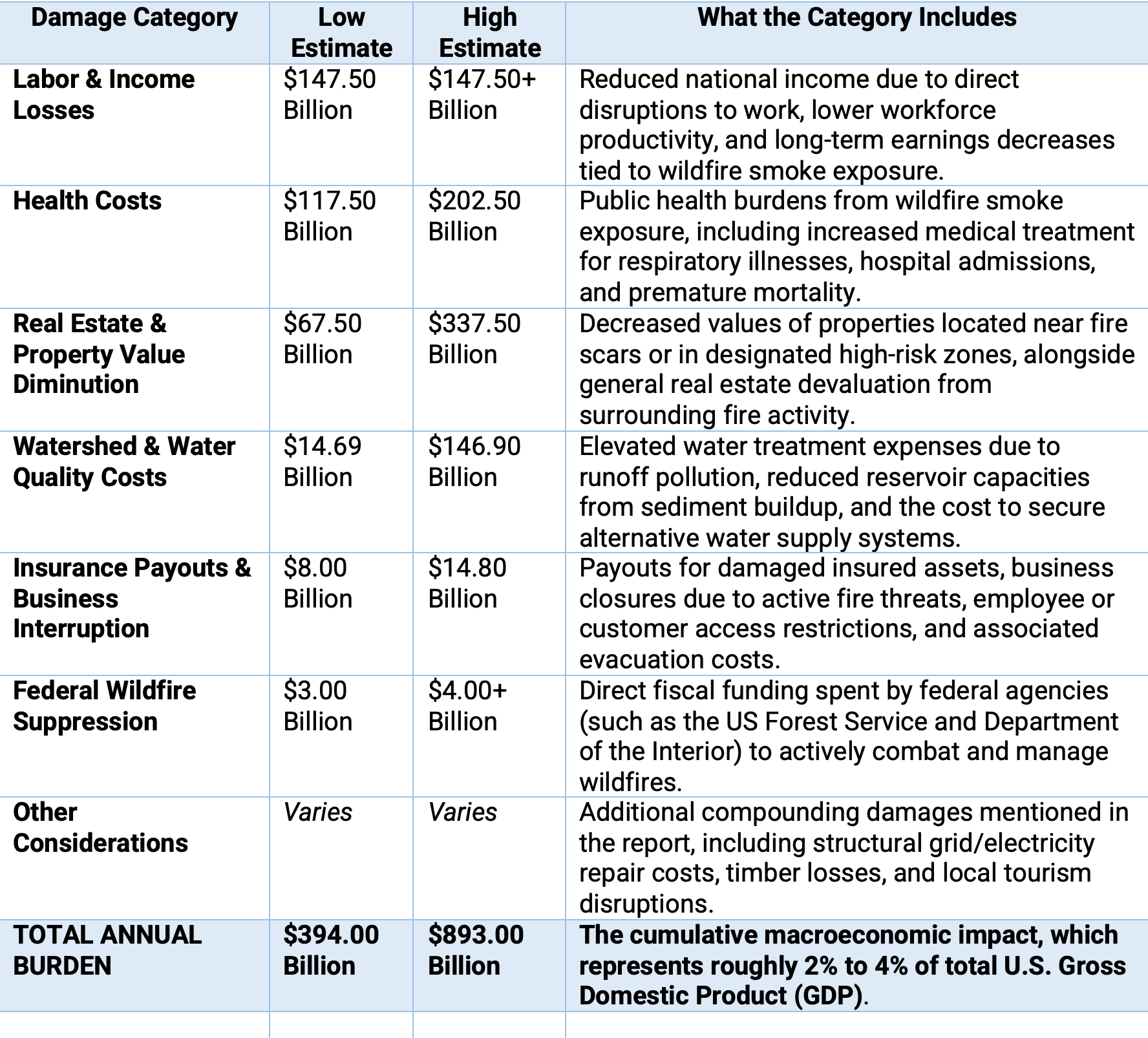
The growing connection between climate change and wildfires is placing mounting strain on economic systems by disrupting markets and generating widespread financial losses. A 2017 review by the National Institute of Standards and Technology (NIST) had placed climate-exacerbated wildfire costs at between $71.1 billion to $347.8 billion annually. In 2023, the U.S. Congressional Joint Economic Committee (JEC) built on that work by broadening what counts as wildfire damage. Rather than focusing mainly on direct destruction and immediate recovery costs, the JEC incorporated a wider set of indirect, long-term, and economy-wide losses, raising the NIST range to between $394 billion and $893 billion per year.
The JEC expansion is important because many wildfire costs occur well beyond the burn perimeter and long after the flames are out. The report adds categories that earlier estimates often treated incompletely or left out, including smoke-related illness and premature death far from the fire itself, lost wages and reduced productivity from evacuations and unsafe air, lower property values in high-risk areas, higher insurance payouts and business interruptions, damage to watersheds and water systems, tourism losses, timber losses, and repairs to electrical infrastructure.
By counting a wider range of often compounding effects, the JEC provides a more comprehensive measure of how wildfire damages spread through the broader economy and why a full accounting is so difficult. Table 1, our summary of the study, shows the effects to be particularly burdensome in the first four categories. Taken together, they show that wildfire damage is not only a matter of burned structures and suppression costs; it is a national economic burden that spreads across many systems over time.
Table 1. Annual Wildfire Damages by Category (JEC Report)
The analysis underlying Table 1 provides useful insight into the potential magnitude of damages but it doesn’t help communities identify where damage is likely to occur so they can invest sooner in prevention, preparedness, and resilience. Gaining this insight will require greater understanding of the physical feedbacks at play and the various pathways to destruction.
These predictive simulations will require coupling wildfire modules with state-of-the-art climate Integrated Assessment Models (IAMs) so the expanded frameworks can be used to estimate the economic, social, and ecosystem damages caused by fires. Because climate conditions shape wildfire risk – and wildfires alter landscapes and affect emissions, health, infrastructure, and natural capital – these models need to capture both directions of the climate-fire relationship. Doing so would give policymakers a fuller picture of future wildfire costs and help them target prevention, preparedness, and resilience investments more effectively.
Final comment
But waiting for better predictive tools is not an option. The risk of these fires spinning out of control is far too high, and the consequences too severe, to justify a passive approach. We must assist those currently in danger, while we invest in greater resilience for the future. Shifting our strategy from managing damage to actively preventing it depends heavily on stronger data systems and improved climate and wildfire models. This makes proposed administration cuts to climate research and modeling programs deeply problematic. Reducing funding would weaken the essential tools required to predict fire risks, guide safety investments, and minimize future destruction. Cutting these programs is both short-sighted and misguided, especially since dangerous fire weather will not wait for us to prepare.
To the reader: If you find this post of interest, please share it with others.
_________________
Richard Richels was lead author for multiple chapters of IPCC studies in areas of mitigation, impacts and adaptation.
Richard B (Ricky) Rood is Professor Emeritus, Climate Science, University of Michigan, Ann Arbor; writer, speaker. https://OpenClimate.org/
Henry Jacoby is William F. Pounds Professor of Management (emeritus), M.I.T.
Gary Yohe is the receiving agent of Gary W. Yohe, LLC and Huffington Foundation Professor of Economics and Environmental Studies (emeritus), Wesleyan University.