
On Interpreting Weather Disasters
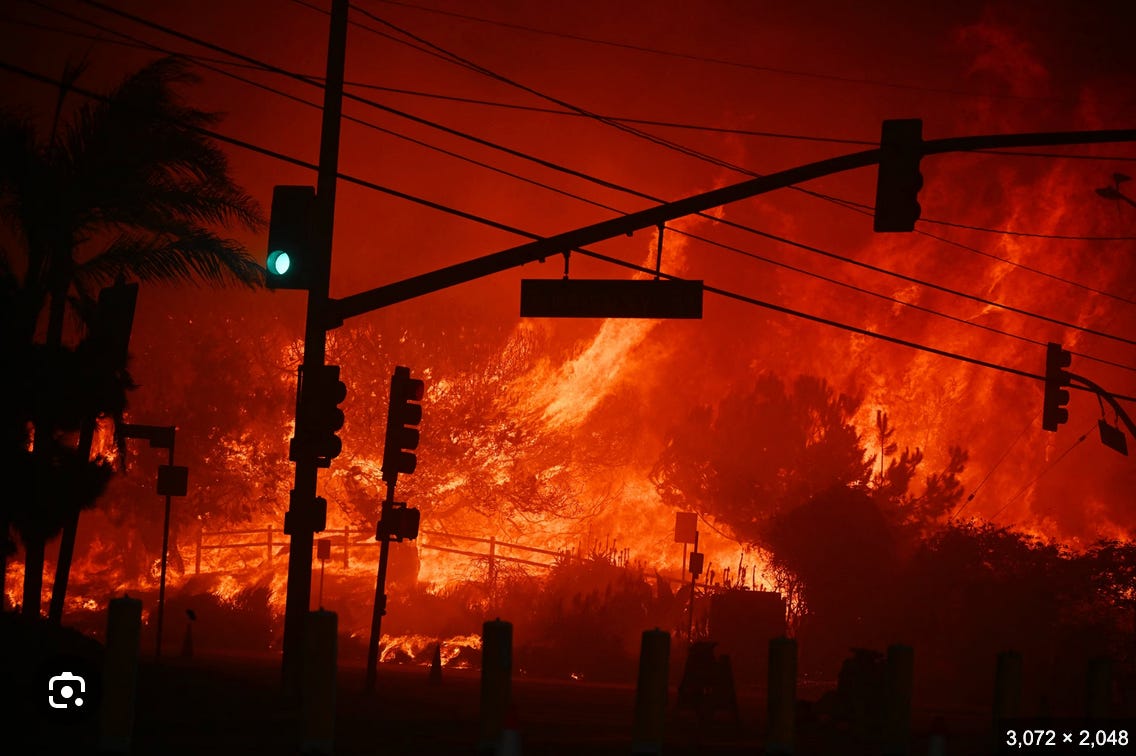
It matters how we talk about weather disasters, like a damaging flood or devastating fire. One description may allow for the possibility of deeper understanding what has happened and why. The use of other adjectives may intimate denial of a climate influence or simply serve to push the experience out of mind.
Watch your language
How many disasters, how many demolished homes, how many billions in economic loss, and how many neighbors must die before climate-related catastrophes cease to come as a surprise? Particularly troubling is the use of words like “unimaginable” to describe these catastrophic events. This term clouds the mind when trying to interpret the array of disasters. It suggests that what was experienced was an irreproducible fluke of nature, an “Act of God” beyond human influence. The word “unimaginable” thus conveys the notion that there’s nothing anyone could have done about it.
The use of this description can be tactical, supporting the forces of climate denial. For example, President Trump described the flood in the Texas Hill Country as an “unimaginable” tragedy, which is consistent with his view that the suggestion of a climate related cause is a con job, a hoax, a scam. Florida Senator Rick Scott used the same term when he described hurricane Michael. If the event is unimaginable, why try to imagine action that might make a difference?
Unfortunately, this description also penetrates common speech and press accounts. For example, it showed up in NPR’s coverage of Kentucky Governor Andy Beshear’s response to a tornado, describing the death and destruction as “unimaginable”.
When an extreme event happens
If terms like unimaginable can be avoided, some useful questions arise. Was this event really that rare or extreme? If so, why did it happen? And are there actions we can take to reduce the risks and damages of events in the future?
In the wake of an extreme event, such as a weather disaster, one could take a page from Major League Baseball (MLB). For a few years after 2014, the number of home runs increased dramatically. MLB is heaven for people who love statistics, and the data was available to show that a fundamental change from “normal” Major League experience was under way. The change in home run performance was described as “enormous”, “mysterious”, of “astronomically small probability”.
But unimaginable? No. The MLB established a committee of physics and statistics professors to figure out what was going on. Were batters suddenly just swinging for the fences? Were balls being “juiced” so they had more energy coming off the bat?
It turned out that an important cause of the increase in home runs was happening while the balls were in the air. Very small changes in the surface of the official MLB balls had reduced their drag coefficient in flight. The Committee’s conclusion led to recommendations for possible remedies and quality-control measures.
What’s up with the weather?
Extreme weather also has been the focus of extensive statistical studies, many carried out to estimate expected risk to the public. For example, in support of the National Flood Insurance Program, FEMA calculates the likelihood of inundation in flood hazard areas. It is a “backward-looking” analysis (like a summary of pre-2014 home run performance), based on historical precipitation and river flooding. FEMA calculates the flood level with a 1% chance of occurring in a year. This risk estimate is usually stated as the level that is expected only once every 100 years, or the 100 year-flood. FEMA also calculates a 500-year flood, the one with a 0.2% probability in any year.
Are recent floods really that extreme in comparison with the historical record? The answer is “yes”. The Houston region, for example, saw three storms in a short period (Harvey in 2017, Imelda in 2019 and Allison in 2021). Each was more extreme than the 100-year storm estimated based on pre-2010s experience. Or, as is shown in a study of U.S. coastal risk, the historical 100-year flood should now be expected once every 30 years if one accounts for the changing climate and associated sea level rise.
The rising risk of extreme flooding is also evident in a nation-wide summary of precipitation, which shows an increase over time in the number of extreme one-day events.
Similar patterns of increase can be seen in statistics of other areas of climate-related weather risk, such as the number of heat waves, or the area of US forests experiencing high fire-season fuel aridity.
Elementary my dear Watson
As with the increase in home runs, the obvious question is, “Why is this happening?” Decades of effort by natural scientists and statisticians have been devoted to this question. In the sub-field of attribution studies, scientists prepare estimates of the probability that a particular weather event was made more severe and/or more likely by human-caused increases in temperature and moisture.
Even without these detailed statistical studies, however, there is valuable information to be gleaned from deep dives into the physical process behind many of these disastrous events. Wherever you look, a warming climate is playing a role. Ocean temperatures, which are rising, are the main force driving the strength of tropical hurricanes. Warmer air holds more water, which increases rainfall intensity and flooding. Warmer air also increases evaporation, pulling moisture from vegetation and soils, producing more flammable fuel, and increasing the intensity and area burned by forest fires.
The message
Recognition of the role of rising temperature is critical in interpreting the frequency and magnitude of extreme weather events. This understanding becomes even more important considering that the warming is projected to continue, and perhaps even accelerate, in coming years. Current weather disasters are a harbinger of worse to come, and they point to a host of needed responses. For example, greater investments in resilience are going to be called for, and more effort should be going into planning and preparation for the draw on federal and state budgets.
Other issues that will affect all of us relate to the distribution of the cost of increasing weather disasters among the public. Who bears the burden is to a substantial degree a matter of public policies, and they are now inadequate to the challenge. Systems of property insurance (both private and federal), which to some degree socialize the cost of weather disasters, are already under severe stress in vulnerable regions. The structure and regulation of insurance markets are going to have to adjust to the rising risks. And federal disaster aid provided mainly by FEMA will need to be strengthened, not pushed off onto the states as is now proposed, as if the threat were not worthy of federal attention.
An essential step in this direction, for our leaders and the press and those of us in the public, is to properly name what is happening. The extreme weather events we are experiencing in the United States, and globally, are not a surprise but were foreseen decades ago. They are serious and disastrous. But not unimaginable.
________________________
Henry Jacoby, is William F. Pounds Professor of Management (emeritus), M.I.T.
Gary Yohe, is the receiving agent of Gary W. Yohe, LLC and Huffington Foundation Professor of Economics and Environmental Studies (emeritus), Wesleyan University.
Kristie Ebi, is a principal in ClimAdapt, LLC.
Bud Ward, spent five decades as an environmental and climate change journalist and educator.
Benjamin Santer, is atmospheric scientist who has worked on all previous Scientific Assessment Reports of the IPCC.
Richard Richels, was lead author for multiple chapters of IPCC studies in areas of mitigation, impacts and adaptation.
I agree with your point about language, but there's gross hypocrisy in this post using a flaming wildfire background as its header. This implies for the uninformed that these disasters have a climate change impulse. The IPCC and numerous independent scientists have routinely demonstrated that wildfire frequency in the US is down on the past, and has numerous confounding human caused drivers now, even so, including failures to remove litter debris in forests and do controlled burning prevention, along with lamentable financing and action in firefighting.
I stand with IPCC reports on climate change up to this point. I am aware of activist scientists' moves to use their own models to deliver 'attribution' estimates on floods (however defined). These make a range of obscure assumptions to inform us that the 'risk of such and such a flood' was x% higher 'because of climate change'. It is simply not possible to infer local regional outcomes in 'weather' from global modelling, without simply delivering on your priors. We are getting more intense and frequent rainfall as IPCC says, but then to aim that to 'floods' and greater risk is a step too far for our modelling capacity.
The only point to this attribution development is to provide material to journalists to alarm people. It makes not one jot of a difference to actually understanding climate change. In my view attribution modelling is 'weather truthing' and serves to undermine the credibility of serious climate change work.
This was very well done. The language used to describe these catastrophes should be considered in every response. Thanks for this!